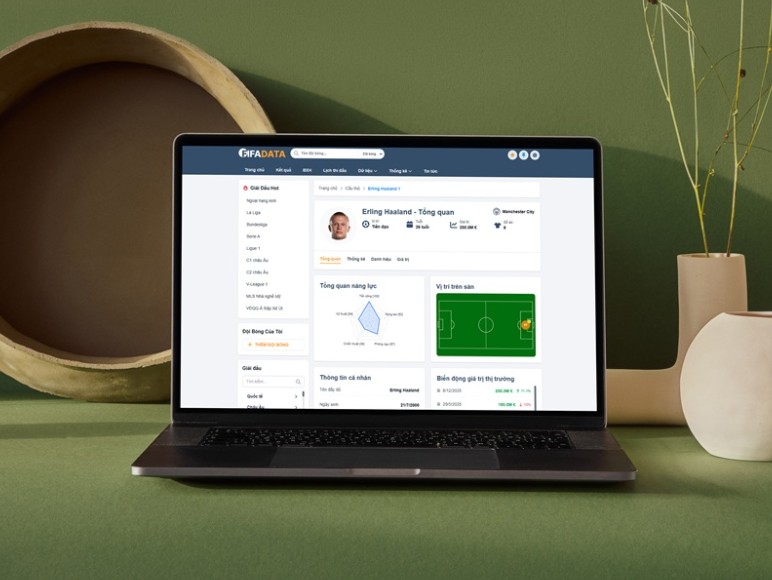
The website Fifadata launched its version 2.0 upgrade in 2025 with a significant set of technical claims. This Q&A addresses the most common questions from Vietnamese football fans who want to know whether the platform lives up to them – including where it genuinely leads the market and where it still has room to grow.
Q1: What Exactly Is Fifadata?
Fifadata is a Vietnamese football data platform that covers live scores, league standings, match statistics, player profiles, and transfer data across 5,000+ competitions worldwide. It operates at www.fifadata.com and is free to use.
The platform was not adapted from an international product for the Vietnamese market. It was built with Vietnamese fans as the primary audience from the start. The interface is 100% Vietnamese, all match times display in Vietnam Standard Time (GMT+7) by default, and the editorial content is written in Vietnamese rather than translated from another language.
Version 2.0 introduced major upgrades across every part of the platform – from data infrastructure and competition coverage to advanced analytics and user interface. The upgrade represents the largest single improvement in the platform’s history.
Q2: How Fast Are the Live Scores?
Live scores on Fifadata update in 0.3 seconds. The industry average sits at 0.5 seconds. In practice, this means FIFADATA regularly updates before TV broadcast graphics do.
This performance is delivered by the FifaData Engine™, a proprietary data processing system developed over five years. The engine processes 500 million data points every day. It runs AI-powered anomaly detection continuously, which catches irregular data automatically before it reaches users.
The supporting infrastructure includes server capacity three times higher than the previous generation and auto-scaling technology that maintains 0.3-second performance during peak traffic. Page load times across the platform sit under 0.2 seconds, achieved through code optimization and lazy loading that reduced total page weight by 40%.
Q3: Does It Cover Vietnamese Football Properly?
Yes – and this is one of Fifadata’s clearest advantages over every international competitor. No platform serving the Vietnamese market covers domestic football at this depth.
Version 2.0 expanded total coverage from 1,000+ to 5,000+ competitions worldwide. Within Vietnam, this includes V-League (Hạng Nhất), Hạng Nhất (second division), Hạng Nhì (third division), Hạng Ba (fourth division), amateur and regional leagues, the national women’s league, and youth tournaments at the U17, U19, U21, and U23 levels.
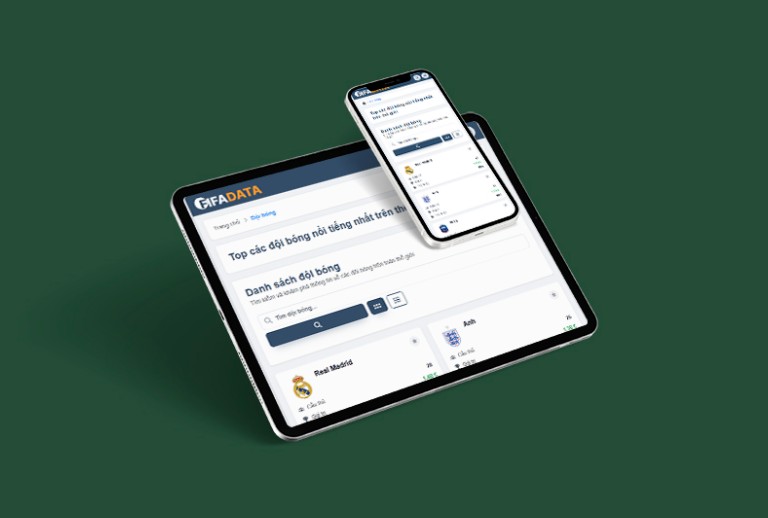
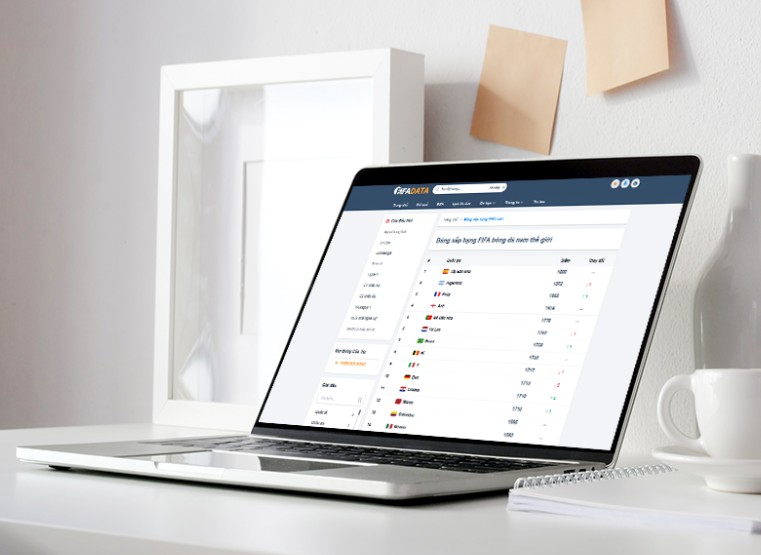
International coverage is equally broad. The UEFA Champions League, UEFA Europa League, AFC Champions League, Copa Libertadores, and all five major European domestic leagues are covered in full. FIFA World Cup qualifying rounds are tracked from the start, not just from the final tournament stage. This expanded coverage is sustained by a partnership with TheSports (ONE SPORTS LIMITED, Singapore), which supplies data feeds for 1,800+ football leagues with millisecond-latency updates.
Q4: What Advanced Statistics Does It Offer?
Fifadata provides three advanced analytical tools that go well beyond the scoresheet: Expected Goals (xG), Heat Maps, and Pass Maps. These are available free on every match the platform covers.
The xG model is trained specifically on Asian football data. It evaluates each shot across more than ten parameters, including shooting distance, angle to goal, defender pressure, goalkeeper position, shot type, and match context. This produces a shot probability figure grounded in the patterns of Asian football rather than borrowed from a European dataset.
Heat maps display each player’s positional activity as a color-coded overlay on the pitch. High-activity zones appear in red and orange. Low-activity zones appear in blue and green. The maps are filterable by match phase, allowing fans to track how a team’s structure changed across the course of a game.
Pass maps render a team’s ball movement as a visual network. Line thickness reflects how frequently two players exchanged passes. Color reflects whether those passes were successful. A single pass map identifies a team’s primary ball-circulation hub and reveals tactical patterns that no statline captures alone.
Q5: How Accurate Is the Data?
Fifadata maintains a documented accuracy rate of 99.8% across all data types. This is an improvement from the 99.5% standard in the previous version of the platform.
The platform uses a three-tier verification system. The first tier is cross-source verification: every data point is checked against multiple independent feeds before publication. Discrepancies trigger review before data goes live, not after a user spots an error.
The second tier is AI anomaly detection. Machine learning models flag data that deviates from statistically expected ranges automatically. A player credited with three goals in a match where two were scored is caught at this stage. The third tier is human review: a team of 10 dedicated Sports Analysts manually verifies high-priority matches and edge cases that automated systems flag for attention.
Data is sourced from 30+ global partners, including official feeds from FIFA, UEFA, and AFC. The primary infrastructure partner is TheSports, whose client list includes Warner Bros Discovery, Perfect World, and PlanetSport. This places Fifadata’s accuracy standard at a global benchmark, not a regional one.
Q6: Is the Player Database Actually Useful?
With 1,000,000+ profiles, the database is the largest player record in Vietnam – and it goes well beyond basic career statistics.
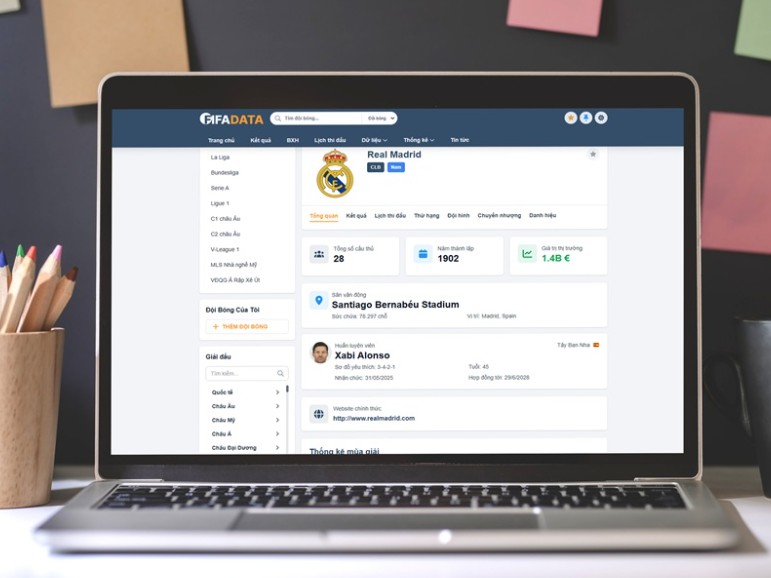
Each professional-level profile on FIFA DATA includes four layers of information. Personal and physical data covers nationality, date of birth, dominant foot, height, and weight. Career statistics break down goals, assists, xG, key passes, tackle success rate, aerial duel percentage, and pass accuracy by season and competition.
Individual honors cover Golden Boot awards, Ballon d’Or nominations, FIFA Best appearances, and national team records. The financial layer includes current market value, a historical value chart showing the full career trajectory from emergence through peak to present, and a complete transfer history with confirmed or estimated fees for every club move.
The market value chart is particularly useful during transfer windows. It allows fans to evaluate whether a reported transfer fee reflects a player’s current standing or a premium above it – context that basic statistics alone cannot provide.
Q7: How Does the Interface Hold Up on Mobile?
The interface performs well on mobile. Page load times under 0.2 seconds apply across desktop and mobile alike, and the platform is fully responsive – layouts adjust automatically to screen size.
The version 2.0 redesign introduced a fully implemented Dark Mode. This is not a color inversion but a purpose-designed dark theme with contrast ratios optimized for extended nighttime use – which matters for Vietnamese fans following late European fixtures.
The platform also supports Progressive Web App (PWA) installation. Users install it directly from their mobile browser, with no app store download required. The PWA delivers near-native performance – service worker caching accelerates repeat visits, and offline access to saved content is available. Native iOS, Android, and Huawei AppGallery applications are currently in development, with a launch target of 2026.
Q8: Is It Really Free?
Yes. Every feature on Fifadata is free. There is no subscription tier, no premium paywall, and no advanced analytics reserved for paying users.
This includes live scores across 5,000+ competitions, the full player database of 1,000,000+ profiles with market value charts, xG and heat map data for every covered match, league standings with position trend charts, transfer data, Head-to-Head history, and personalized features such as followed teams, saved matches, and match reminders.
The free model is made sustainable in part by the cost efficiency of the TheSports data partnership, which supplies professional-grade data at pricing reported to be 70% below market rate. This allows Fifadata to maintain global-standard data infrastructure without passing costs to users.
Q9: What Are Its Weaknesses?
No platform at this scale is without limitations, and Fifadata is no exception. Two areas are worth noting honestly.
At the very bottom of the competition pyramid – small regional leagues and grassroots competitions – Fifadata provides fixture results and basic standings, but player-level statistics and lineup details become limited. This is partly an industry-wide data availability issue: comprehensive statistical tracking does not exist for every tier of every competition globally. However, fans of lower-division football outside Vietnam’s top tiers will find the analytical depth that exists for major leagues is not uniformly replicated here.
The second limitation is the absence of a native mobile application. The PWA delivers solid performance, but a purpose-built native app – with deeper push notification systems, home screen widgets, and Touch ID or Face ID login – will offer a meaningfully better mobile experience. That application is in development and targeted for 2026, but it is not yet available.
Q10: So – Is Fifadata the Best Football Data Platform in Vietnam?
For Vietnamese football fans, yes. No other platform serving this market combines domestic coverage depth, live data speed, advanced analytics, and genuine Vietnamese localization in a single free product.
The case rests on five measurable advantages. Live scores update in 0.3 seconds – faster than the industry average and faster than most broadcast graphics. Competition coverage at 5,000+ competitions includes every tier of Vietnamese football that international platforms ignore entirely. Advanced analytics – xG, heat maps, and pass maps – are available free on every match, at a standard that most platforms charge subscription fees to access. Data accuracy is maintained at 99.8% through a three-layer verification system backed by global broadcaster-grade infrastructure. And the platform is built in Vietnamese, for Vietnamese fans, with 10,000+ localized terms and automatic GMT+7 time conversion.
The acknowledged weaknesses – statistical depth at lower competition tiers and the absence of a native app – are real but neither undermines the core product. They are the next phase of development, not fundamental gaps in what the platform delivers today.
For anyone evaluating football data platforms in Vietnam, the website FIFADATA is the most complete option currently available. The version 2.0 upgrade has set a standard that competitors in this market have not yet matched.