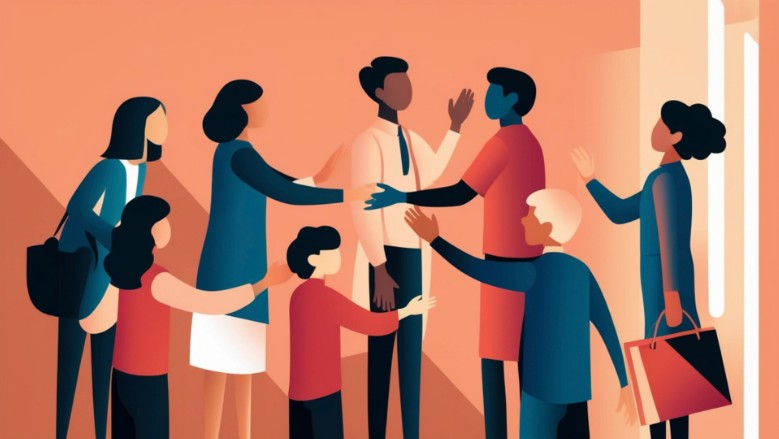
Work doesn’t feel the same anymore. In today’s hybrid work culture, quick chats and small moments have been replaced by messages and meetings. It’s easier than ever to stay busy, but harder to feel connected.
That missing human touch matters more than we think. Simple, thoughtful employee greetings and personalized greetings for employees can change how someone feels about their day and their team.
They show people are seen, not just managed. The good news is you don’t need big plans or costly employee engagement ideas. Small, consistent gestures, even using custom e-cards for business, can rebuild real connections over time.
Key Strategies for Custom Greetings at Work That Feel Genuine
Knowing when to send a greeting covers half the equation. The other half is knowing how to write one that actually lands, rather than one that gets skimmed, filed, and forgotten.
Personalization Framework: “Specific + Shared + Small Detail”
This three-part formula holds up across industries, team sizes, and communication styles. Lead with a specific achievement, something observable, not vague praise. Add shared context, why it mattered to the team or the broader mission.
Finish with a small human detail that reflects how that person actually works or what they value. You don’t need to be a gifted writer. You just need to pay attention.
Privacy and Consent Guardrails
Not everyone wants a team-wide birthday announcement. Some people actively dread it. Build genuine opt-in systems for public recognition, avoid surfacing sensitive personal data, and give employees the ability to choose “month-only” visibility for birthdays if they prefer.
Consent-aware systems protect your people and, by extension, protect the credibility of your entire culture-building effort.
With a solid strategy in place, the next move is choosing the right format, and for moments that mean more than a quick Slack ping, Personalized ecards deliver something a quick message simply cannot replicate.
Culture Signals Hidden in Everyday Greetings
The way your organization greets people tells them, without a single policy document, what you actually value. A thoughtful first-day welcome, a meaningful anniversary acknowledgment, a genuine thank-you after a tough stretch- these speak volumes. Far more, honestly, than whatever’s printed on the values poster in the break room.
Greetings as “Micro-Moments” That Shape Belonging
Recognition sets off a chain reaction that most leaders genuinely underestimate. Someone feels seen → trust starts forming → trust builds psychological safety → psychological safety enables real performance. The whole sequence can kick off with a single well-crafted message. That’s not idealistic. That’s how it actually works.
Hybrid Work Makes Greetings a Cultural Infrastructure
Distributed teams lose organic recognition almost immediately. Milestones vanish across time zones. Informal appreciation rarely survives the journey through a Slack thread. In this environment, greetings become a kind of always-on infrastructure for modern workplace communication, a reliable touchpoint that no floor plan or office redesign can replicate.
If small recognition moments matter in a shared office, they become absolutely non-negotiable when your team is scattered across cities, continents, and living rooms with spotty Wi-Fi.
The Cost of Generic Messages
Mass birthday blasts and copy-pasted “Congrats on the anniversary!” messages don’t just fall flat, they actively communicate indifference. When something feels templated, people notice. And weirdly, a hollow message often lands worse than no message at all. The standard worth building toward is simple: specific + relevant + timely + human. That combination is what separates real appreciation from performative noise.
High-Impact Moments for Personalized Greetings for Employees
Understanding why greetings shape culture is step one. Knowing when to deploy them, intentionally and strategically, is where things get practical. And the answer extends well beyond the birthday reminder sitting in your HR calendar.
First-Week Onboarding Greetings That Reduce Ramp Time
The very first message your organization sends is the highest-stakes greeting you’ll ever craft. A strong welcome includes role clarity, a practical guide to who handles what, and a buddy introduction.
Layer in a short async team note, even a brief, unpolished video, and new hires start building social context before their second week.
How someone feels during week one quietly determines whether they’ll still be around by year two. It’s that connected.
Work Anniversaries That Reinforce Growth and Purpose
Anniversaries are not just calendar triggers. They’re an opportunity to narrate someone’s growth story out loud. Tie the milestone to something tangible, a skill built, a project delivered, an impact made.
Ask the manager to add one specific line: “Name something they taught the rest of us.” That single sentence turns a routine acknowledgment into something worth screenshotting and saving.
Recognition After Invisible Work
Operations saves, behind-the-scenes coverage, quiet crisis de-escalations, this work gets missed constantly. Making invisible labor visible requires a deliberate framing approach: problem → action → outcome. When someone kept everything running while nobody was watching, that story deserves to be told clearly and publicly.
Transitions and Difficult Moments
Promotions, parental leave returns, internal moves, all of these call for messaging that’s genuinely thoughtful, especially consent-aware re-welcomes after medical leave. For harder moments like bereavement or burnout recovery, skip the forced optimism. Offer options, honor autonomy, and keep it human and brief. There’s no script for grief, and pretending otherwise just adds distance.
Custom eCards for Business That Employees Actually Want to Receive
Not every moment deserves the same medium. Understanding where e-cards outperform messaging apps and emails helps you reach for the right tool at the right time, rather than defaulting to whatever’s easiest.
When eCards Win vs. Other Channels
Ecards carry a sense of ceremony that casual chat messages can’t match. They’re permanent, shareable, and can hold signatures and notes from an entire team.
Messaging apps are unbeatable for speed and informality. Email serves formal moments well, especially when leadership visibility matters. Each channel has its strengths; the skill is knowing which to reach for.
When you want to mark milestone recognition, support cross-team appreciation, or create a genuine onboarding welcome, personalized e-cards add a layer of thoughtfulness that simple messages miss. For companies trying to build a cohesive culture across distributed teams, they’re genuinely worth the investment.
Anatomy of a Great Custom eCard
Brand-aligned design that doesn’t feel stiff, room for multiple contributors, and optional media like GIFs or short video clips all elevate the experience significantly. On the message side? Two precise, specific sentences outperform three generic paragraphs every single time. Specificity is the real difference between a card someone keeps and one that disappears into a folder.
eCard Categories That Map to Engagement Goals
The most effective uses go well beyond birthdays. Peer-to-peer appreciation, manager recognition, cross-functional gratitude, and internally forwarded customer praise are all powerful categories.
When employees see real customer feedback transformed into a team shoutout, it draws a clear line between their daily work and real-world impact, and that connection is quietly motivating in a way that company-wide all-hands rarely achieves.
| Greeting Moment | Best Format | Key Element |
| Onboarding welcome | Group eCard + async video | Role clarity + team warmth |
| Work anniversary | Custom eCard with signatures | Impact story + growth detail |
| Invisible work recognition | Private or team message | Impact framing: problem → outcome |
| Promotion/transition | eCard with manager note | Forward-looking, not task-heavy |
| Difficult moment (leave return) | Private, consent-first | Brief, human, no forced positivity |
| Customer praise forwarded | Team eCard or Slack | External validation made visible |
Automation Without Losing the Human Touch
Even the most carefully built greeting strategy stalls without a system to sustain it long-term. The real unlock is automation that handles the when while keeping humans firmly in charge of the what.
Trigger-Based Workflows and AI-Assisted Drafting
HRIS events, hire dates, anniversaries, and promotions can automatically prompt the right message at exactly the right moment. Project completions and key calendar milestones work the same way. The non-negotiable piece: always build in a human checkpoint so automation never fires off an unreviewed message during a sensitive situation.
AI can solve a real problem here, helping managers quickly find specific, authentic language instead of staring at a blank message box. A useful AI prompt includes context inputs covering impact, tone, and values; a list of forbidden filler phrases; and at least one concrete detail that proves the message is genuine. And if AI assistance is used internally for drafting, brief transparency keeps organizational trust intact.
Recognition Preference Profiles and Cross-Channel Delivery
Let employees tell you how they want to be recognized, public versus private, humor level, preferred channel, and any opt-out periods. Pair those preferences with time-zone-aware scheduling across Teams, Slack, email, and HR platforms.
When the right message shows up through the right channel at the right moment, it actually lands instead of getting buried.
Measurement: Proving Custom Greetings Improve Engagement
Playbooks and templates create the consistency you need, but earning long-term organizational buy-in requires demonstrating that custom greetings at work actually move real culture metrics, not just warm feelings.
Track participation rate (who sends), coverage rate (who receives), and response quality (genuine replies, not just emoji thumbs-ups). Audit equity across departments, levels, and locations. Connect those signals to new hire ramp feedback, eNPS items like “I feel recognized here,” and internal mobility interest over time. Run a proper 90-day baseline before changing anything; you’re comparing apples to air.
The most predictable failure modes are worth knowing early: greetings originating only from HR (fix: peer-driven prompts), birthday spam fatigue (fix: opt-in systems), and generic, content-free praise (fix: impact-based frameworks). Catching these patterns early is a genuine competitive edge.
Frequently Asked Questions
1. What is the purpose of professional greetings?
Professional greetings are the opening phrases used in workplace communications or customer interactions. They set the tone, show respect, and clarify a message’s purpose while signaling professionalism and courtesy to the recipient.
2. What is the cultural significance of greetings?
Greetings are how people acknowledge each other and initiate social interaction. They’re foundational to social etiquette, vary widely across cultures, and are deeply rooted in societal norms, values, and traditions that shape how relationships begin.
3. Why is greeting important in the workplace?
A warm greeting sets the tone for the entire interaction. It shifts focus from tasks to shared experience, inviting optimism and camaraderie, especially valuable in fast-paced environments where people can easily feel like just another task on someone’s list.
Custom Greetings in Modern Work Culture
Personalized greetings for employees are not a nice-to-have. They’re a cultural infrastructure decision, one with real downstream effects on retention, cooperation, onboarding success, and the visibility of work that would otherwise go unnoticed and unappreciated.
The strategy doesn’t have to be complicated: identify your highest-impact moments, build lightweight but specific templates, layer in smart automation with human checkpoints, and track what actually shifts over time.
In a world where most communication is functional, rapid, and forgettable, a greeting that makes someone genuinely feel seen is one of the most powerful things your organization can send. Don’t underestimate it.